Little Panda's Cat Game
- 4.6
- Rating
- 10.00M
- Installs
- Free
- Price

 Analysis by App-foxy
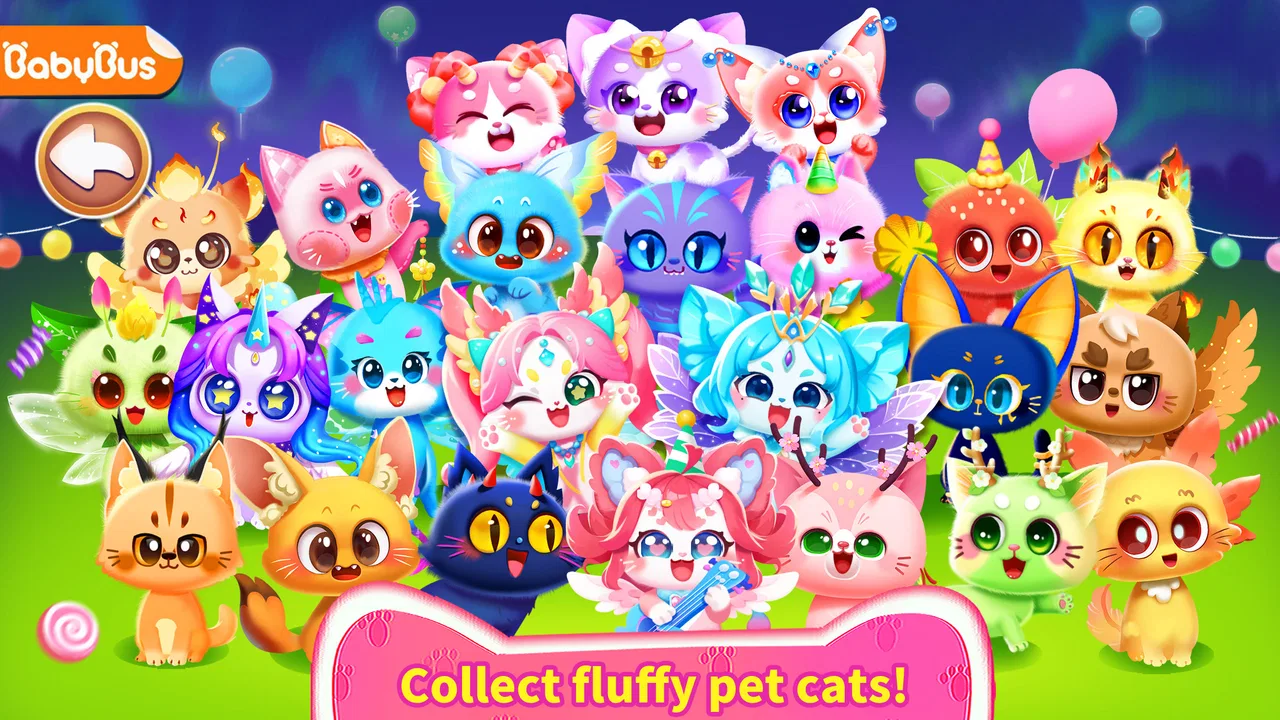
Little Panda's Cat is the kind of educational game I would hand to a young child who enjoys caring for animals more than chasing high scores. Developed by BabyBus, it places the player in a virtual pet setting built around cats, with simple activities connected to breeding, feeding, and dressing them. I found the appeal easy to understand: the game turns everyday care into short, playful tasks rather than presenting lessons as formal exercises.
That simplicity is also the main thing to consider before installing it. This is not a competitive action game, a deep simulation, or a structured school curriculum. It is a gentle cat-themed experience for children who like making choices, checking on a pet, and changing its appearance. My overall impression is positive, especially for brief supervised play, but I would approach the spending side carefully because the game is free to start and includes optional purchases ranging from $0.49 to $29.99 per item.
How the virtual cat world works for young players
The basic loop is easy to grasp. A child enters the pet world, interacts with cats, gives them attention through feeding, and chooses clothing or accessories to change how they look. Breeding adds another reason to return, because it gives the care activities a sense of continuation instead of making every session feel completely separate.
You May Also Like

 Blood Strike: 2.5 Anniversary
Blood Strike’s Loadouts Turn Every Drop Into a Tactical Gamble
A close look at Blood Strike’s custom loadouts: how fast access to signature weapons reshapes its battle royale rhythm, rewards preparation, and narrows the gap between fights.

 Pandora - Music & Podcasts
Pandora’s Music Is Easy to Start, but Harder to Recover
Pandora’s strength is its low-effort path from a seed to a station. Its weak spot is how much confidence it asks you to place in connection, setup, and quiet recovery.

 8 Ball Pool
 Is Built on Rivalries, Rematches, and Routine
A close look at the rivalries, rematches, shared routines, and unanswered safety questions that turn a quick pool match into a persistent mobile community.

 Samsung Music
’s Quiet Strength Is Playing What You Already Own
Its reach comes less from spectacle than from dependable access to a personal library. That simplicity is both the app’s strongest retention engine and its ceiling.

 AccuWeather: Weather Radar
AccuWeather Review: A Quick, Clear Forecast for Everyday Decisions
For everyday plans, the best forecast is the one you can understand quickly. AccuWeather makes rain timing, radar, and local conditions easy to act on, with a few trade-offs.

 Hill Climb Racing
Why Hill Climb Racing Still Turns Crashes Into One More Run
A tiny car, a bumpy hill and one more upgrade: Hill Climb Racing keeps resurfacing because its simple chaos makes every near-miss feel personal.
More From Our News Desk



In my experience, this style works best when a child wants control over a small world but is not ready for complicated menus or demanding rules. The cat theme gives every action an immediate context. Feeding feels like looking after a pet, while dressing turns the same animal into something the player has personally customized. That connection is more engaging for many children than abstract matching or quiz screens.
The educational value is informal rather than academic. Children can practise making choices, following a simple sequence, noticing changes, and thinking about responsibility in a playful setting. I would not use it as a replacement for reading practice, mathematics software, or a teacher-led learning tool. Its strength is that it encourages participation and gentle routine while keeping the subject matter familiar.
The age label is Everyone, which fits the approachable concept and child-friendly presentation. Still, an age label does not tell a parent whether the pace, visual style, or purchase prompts will suit one particular child. Some children will enjoy repeating care activities, while others may lose interest quickly if they want more story, exploration, or challenge.
A useful routine for everyday play
A practical way to use the game is to make it part of a short transition in the day. For example, after coming home from school, a child could spend a few minutes checking the cats, feeding them, and choosing an outfit before moving on to another activity. I prefer this approach to leaving the game open as an all-evening pastime because the experience is built around small interactions rather than a long-form adventure.
Parents can also turn the pet actions into conversation. Instead of simply handing over the device, I would ask the child which cat needs attention first, why a particular outfit matches the chosen look, or what they want to do during the next visit. That makes the game a starting point for language and decision-making rather than a silent screen activity.
One less obvious benefit is the way dressing can support creative comparison. A child can try a look, decide that it does not fit the cat’s personality, and change it without real-world consequences. That kind of low-pressure experimentation is a better reason to recommend this game than the broad label of “educational” on its own.
Progress without turning care into pressure
The most important question for parents is whether returning to the game feels like a pleasant routine or an obligation. Care-based games can be charming because the virtual pet gives the player a reason to come back, but that same structure can create pressure if a child feels responsible for checking constantly. I would introduce this title with clear play boundaries and make sure the child understands that the virtual cats are part of a game, not a real emergency requiring attention at every moment.
Breeding may make progress feel more meaningful, since it gives the pet world a longer arc than feeding and dressing alone. At the same time, I would watch how a child responds to the idea of collecting or developing cats. If the child becomes upset about not unlocking a particular result or repeatedly asks to buy something to move forward, the game has stopped being a relaxed learning activity for that player.
A useful household rule is to separate play decisions from spending decisions. Let the child choose a feeding action or outfit during the session, but keep purchases behind an adult decision. This preserves the creative part of the game while preventing an attractive cat item from becoming an impulse purchase.
The free entry point is helpful because a family can see whether the child actually enjoys the central activities before paying anything. However, “free” should not be treated as the same thing as “without spending considerations.” Optional in-app items are available at several price points, with the highest listed individual price reaching $29.99. I would review the purchase controls on the device before allowing independent play.
What spending means in practice
From a fairness perspective, the clearest fact is that the game costs nothing to begin, while individual in-app purchases range from $0.49 to $29.99. That gives families a low-risk way to try the experience, but it also means the free version sits alongside paid options. I would not promise that every desirable cosmetic or progression-related choice is available without spending, because the purchase information alone does not establish how each item affects play.
That distinction matters. A paid outfit may be purely decorative, or a purchase may be connected to a broader progression choice; without a confirmed breakdown of each item, I would avoid calling the system either generous or exploitative. The sensible approach is to treat purchases as optional extras that require adult review, not as an expected part of caring for the cats.
For a child’s game, the most useful test is whether the child can enjoy a complete short session without immediately being pushed toward payment. I would try the free experience personally first, observe when purchase prompts appear, and decide whether the tone feels comfortable for the family. This is more reliable than assuming that a free download will remain entirely free during normal play.
I also recommend explaining the difference between a virtual reward and a paid item. A child may understand that a new outfit looks different but not understand that tapping a button can charge an account. A quick conversation before play can prevent confusion and makes the adult’s role clear without taking away the fun of choosing styles.
Is the game fair when there is no competition?
Little Panda's Cat is not presented as a head-to-head contest, so competitive fairness is less central than it would be in a multiplayer battle or ranked puzzle game. There is no reason to judge it by win rates or player-versus-player balance. The relevant question is whether spending creates an unfair advantage over other people. In this case, the experience is primarily personal and pet-focused, which reduces that concern.
That does not remove every fairness issue. A child can still compare their virtual cats with friends or siblings, especially when clothing and breeding make the pets feel collectible. If one player has access to more paid options, the social comparison may shift from creativity to ownership. I would encourage children to talk about the choices they made rather than treating the most expensive item as the best result.
The game is a better fit for families who want private, low-pressure play than for children looking for competition or measurable mastery. If your child needs clear goals, difficult challenges, or a strong sense of achievement based on skill, a dedicated puzzle game or educational practice app may be more satisfying. Here, the reward comes from caring for and styling cats, not from proving superiority.
That difference also affects replay value. A child who loves customization may return often because each visit offers another chance to make a different visual choice. A child who wants new mechanics, complex missions, or increasingly difficult tasks may feel that the loop becomes repetitive. I would judge the game by how much the child enjoys imaginative care, not by expecting it to behave like a full simulation.
How it compares with ordinary alternatives
Compared with a standard digital pet game, this title has a clearer educational angle because feeding, dressing, and breeding are framed as simple activities that invite choices and routines. Compared with a formal learning app, it is more playful and emotionally immediate, but it does not offer the same obvious subject progression. Compared with a dress-up game, it adds the care relationship, so the cat is more than a model for changing clothes.
That middle position is where I think it works best. It can fill a short gap when a child wants an interactive animal companion but is not ready for a demanding game. It is less suitable if the family is specifically searching for phonics, arithmetic, handwriting, or a carefully sequenced lesson plan. The word “educational” should be understood here as learning through simple interaction and responsibility, not as a substitute for targeted instruction.
Another trade-off is control. A focused educational app may give parents a clearer idea of what skill a child is practising, while this game leaves more room for open-ended choices. That freedom can be valuable for imagination, but it makes the result less predictable. Two children may use the same cat world in completely different ways: one may focus on feeding, while another spends nearly all the time changing outfits.
Device expectations and practical setup
The current version is 8.75.00.03, and the game requires Android 6.0 or later. That makes the stated software requirement reasonably accessible for families using an older compatible Android device, although the actual experience can still vary with screen size, storage, and device performance. I would install it on the device the child will really use rather than assuming that compatibility alone guarantees a comfortable experience.
A larger screen is likely to make character details and clothing choices easier for small hands to manage. On a shared phone, the game may be perfectly usable for occasional sessions, but a child could accidentally leave the app open or reach a purchase area more easily during handover. A tablet can be more comfortable for supervised play, while a phone is convenient for short, closely monitored use.
Before the first session, I would check the account used for purchases, enable the device’s purchase protection, and explore the opening screens with the child nearby. This is not because the game should automatically be treated as unsafe; it is simply good practice whenever a child’s free game includes paid items. It also lets the adult explain which choices are available freely and which require permission.
Who should try it, and who should skip it?
I would recommend it to a young cat lover who enjoys pretend care, visual customization, and short repeatable activities. It is especially suitable when the goal is a calm shared game that can prompt conversations about choices and routines. The fact that it is free to start makes testing the fit straightforward, provided an adult handles the spending settings.
I would be more cautious for a child who becomes anxious about virtual responsibility, fixates on collecting every option, or has difficulty stopping a repetitive activity. In those cases, a game with clear session endings and less emphasis on returning to a pet may be a better choice. I would also skip it when the family wants rigorous academic practice, competitive challenge, or a rich narrative adventure.
Parents should also consider how much guidance they want to provide. A child who can navigate simple menus independently may enjoy exploring the cat world alone, but younger players may still need help understanding what each action means and when to stop. The best experience, in my view, comes from occasional adult involvement rather than completely hands-off access.
My trust verdict after weighing the trade-offs
BabyBus has made a focused educational pet game rather than an all-purpose learning platform. The concept is clear, the cat theme is approachable, and the combination of care and dress-up gives children several ways to participate. Its public reception is strong, with a 4.7 average from around 13 thousand ratings, and it has passed the ten-million-install mark, which shows that the format has reached a large audience.
Those figures are encouraging, but they do not replace a family’s own test. Popularity cannot tell me whether a particular child will find the repetition comforting or boring, and it cannot answer how a child will react to paid options. I trust the game most when it is used as a short, supervised activity with spending kept firmly in adult hands.
My recommendation is to try the free version as a gentle cat-care game, not as a complete educational course. Give the child room to feed and dress the cats, use the choices to encourage conversation, and watch for signs that the purchase system or repeated progression is becoming the main attraction. If the child enjoys imaginative care without needing constant rewards, this can be a pleasant addition to a family’s app collection.
For my own shortlist, I would keep it for relaxed play and creative pet interaction. I would choose a dedicated learning app for measurable school skills, and a more challenging game for competition or advanced problem-solving. Used within that boundary, Little Panda's Cat feels fair enough to try, honest enough to recommend with spending guidance, and specific enough to earn a place for children who genuinely love virtual cats.
FAQs for Little Panda's Cat Game
01What is Little Panda's Cat Game about?
Little Panda's Cat Game is an engaging mobile app designed for children, focusing on nurturing and caring for virtual cats. Players engage in interactive activities like feeding, grooming, and playing with their virtual pets, promoting responsibility and empathy. The game combines entertainment with educational elements, making it both fun and beneficial for young users.
02Is Little Panda's Cat Game suitable for all ages?
This game is primarily designed for children, typically aged 3 to 8 years old. It features vibrant graphics and simple controls, making it accessible for young players. However, parents might also find it enjoyable to play along with their kids, ensuring a safe and educational experience for their children.
03Are there in-app purchases in Little Panda's Cat Game?
Yes, Little Panda's Cat Game includes in-app purchases. While the game is free to download, certain features, items, or packs may require payment. It's advisable for parents to manage purchase settings on their devices to prevent unintended buys, ensuring a worry-free experience.
04Does the game require an internet connection to play?
Little Panda's Cat Game can be played offline, making it convenient for use during travel or in areas with limited connectivity. However, certain features, such as updates or additional content downloads, may require an internet connection. It's best to check for updates when connected to Wi-Fi.
05How does Little Panda's Cat Game ensure child safety?
The game is designed with child safety in mind, featuring a user-friendly interface and age-appropriate content. It does not contain any harmful materials or advertisements. Parents are encouraged to supervise gameplay and discuss any in-app purchases with their children to ensure a safe gaming environment.
Pros
- Engaging and colorful graphics.
- Simple controls suitable for kids.
- Promotes creativity and learning.
- Regular updates with new content.
- Safe environment for children.
Cons
- In-app purchases can be frequent.
- Requires internet for full features.
- Limited options in the free version.
- May have repetitive gameplay.
- Ads might interrupt playtime.

Little Panda's Cat Game
Gallery